
by John Baldino
Assembling memories from a formatively bizarre year of my childhood is in some ways like cooking dinner when I haven’t been to the store or getting dressed when I’ve neglected the laundry. It’s about taking things that seem to be disconnected, or at least disjointed, cobbling them together, and creating some level of coherence. That’s how I am forming what will attempt to be a somewhat cohesive telling of the year when I was eight and lived in a roadside motel … in Glenburn, Pennsylvania.
But first, some background.
My parents were young and stupid when they got married. Now, I’m not necessarily saying that their marriage was a direct result of their stupidity or that marriage made them stupid. I’m just observing that when they got married, they happened, in addition, to be stupid. Mom was 19, and Dad was 20. They were young. And stupid. As a college professor, I am yet to meet an 18-, 19-, or 20-year-old who is not fundamentally senseless in some aspect. It’s a stupid age occupied by mentally absent—or at least tardy—hormone-driven, pleasure-seeking, shit-talking, junior philosophers. It’s just dumb.
So, two feckless youths—stupid as a default characteristic of their ages—got married. In Carbondale, Pennsylvania. A year later, I came along—much to their surprise. The shock was so great, in fact, that my father (always needing to engage in physical labor when under the smallest degree of stress) shoveled a square block of the City of Scranton upon hearing the news. It was winter, and every neighbor was grateful.
Four years after that, my sister came along. I assume this was less of a surprise as there are no family stories of my father mowing a baseball field or building an ark in 1978.
Four years later, as youth would have it, my parents were separated; and my mother, my sister, and I were living in a roadside motel … in Glenburn, Pennsylvania.
—
Glenburn is on the northern tip of a small area of northeastern Pennsylvania called the Abingtons. It consists mostly of a four-lane stretch of routes six and 11 strewn with roadside motels, a couple restaurants, and the occasional deer carcass and dead cat. (More on those later.) The Abingtons is a hoity toity suburban area adjacent to the City of Scranton. What Glenburn lacks, the rest of the Abingtons boasts in abundance. They have such amenities as a superior local school district with stupidly high property taxes, a dozen unprofitable boutiques owned by the spouses of subsidizing doctors and lawyers, and nary dollar store as far as the Ray-Bans can see. In short: wealth. A richness of income and revenue as plentiful as Glenburn’s roadkill. The small region is made up of municipalities including South Abington Township, North Abington Township, Clarks Summit, Clarks Green, Waverly … and Glenburn, Pennsylvania. The small, impoverished municipality is easily forgotten by Abington snobs and even unknown to their sheltered and presumed-to-be-gifted children.
—
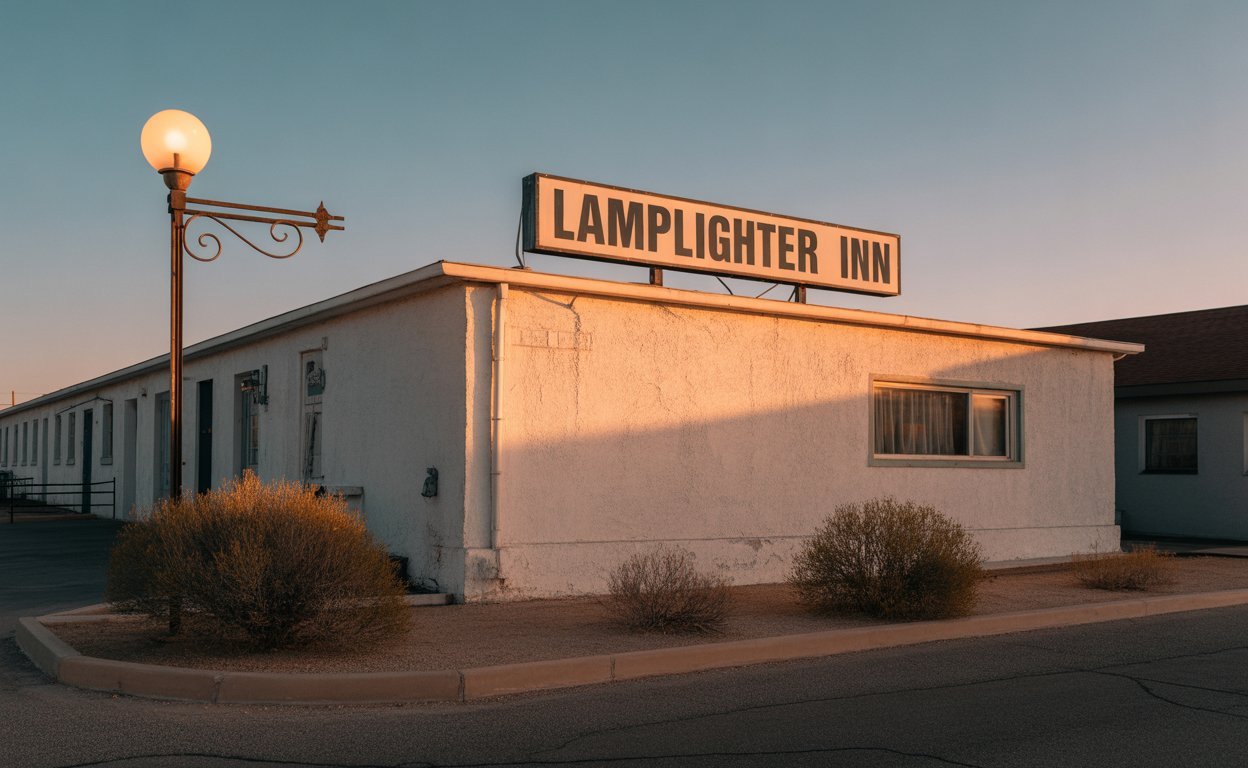
My maternal grandparents’ house was set back a bit. It sat along a two-lane road connecting the small city of Carbondale to the even smaller borough of Simpson in the northeast corner of Pennsylvania. They referred to Belmont Street as a highway. I argued the point even in my single-digit youth. They argued back. That is until they purchased the Lamplighter Inn. It was a run-down white stucco roadside motel on the four-lane combination of U.S. Routes Six and 11 in Glenburn, Pennsylvania. That was a highway, at least in the eyes of an eight-year-old in 1984.
—
The Lamplighter Inn was a six-room motel with a three-bedroom apartment attached. An L shape, the white stucco, one-story building sat on a small incline along the busy highway. It was intended to be a quick stop for many and likely was a last resort for most. For my mother and sister and me, it was home—objections, location, and four-lane playground notwithstanding.
Our front lawn had white lines painted on it. It was a parking lot.
There was a smell: part must, part cat, part spice of some kind.
The front desk was in our living room.
A payphone and a Diet Rite machine stood guard outside our front door, looking out on the paved lawn and supplying me with a bit of cash from time to time. I checked them both for forgotten change every day. Someone gave me that tip, maybe my grandfather. I was the only kid in school with a self-funded Diet Rite habit. To be fair, I was the only kid in school with any kind of Diet Rite habit.
My sister and I were told that the guests would be truck drivers. Looking back, this makes sense as the motel sat on a stretch of highway that connected Wyoming County, Pennsylvania and the southern tier of New York with the Scranton metropolitan area.
The first check-in was a couple in their 70s.
“Mommy, they’re truck drivers?” I asked skeptically and a bit too audibly for the discerning taste of my mother-turned-innkeeper.
“Shh!” She checked them into room four, on the end. Farthest away from our connected apartment.
It seemed unlikely to me that an elderly (by an eight-year-old’s standards) couple would live their lives hauling goods and machinery in giant 18-wheeled machines. I imagined them using one of those staircases on wheels that people used to get on planes and that were eventually replaced by jetways. Did they have a goldfish in a bowl on the dashboard as a pet? If they did, they left it in the truck. There was no truck, though. Not that I saw. Come to think of it, I never saw a truck on our paved front lawn. Where did they park?
—
My sister killed my cat.
In what was probably an attempt to distract us from or overcompensate for our parents’ separation, my mother got my sister and me each a cat. Two gray cats emerged from nowhere on Easter morning. I named mine Mable after a cat in an episode of the animated Spider-Man series. “I think I’ll call her ‘Mable.’” An unrememberable number of months later, my sister threw Mable out a first-floor window. Mable was nicer than my sister’s cat, Casper. She tried to dress Casper in doll clothes and push him around in a tiny stroller. I’d be mean, too.
We lived along a four-lane highway, remember. So, while Mable’s fate is unknown, splattering on the grill of an 18-wheeler is more than a reasonable possibility and almost a logical conclusion. My mother told eight-year-old me that the cat must have run out the door when it was ajar. The family kept up the lie until I was in my late 30s. Then mom let it slip one evening when we were all gathered around her dinner table (no longer in the dining room/lobby of an apartment attached to a roadside motel in Glenburn, Pennsylvania). She covered her mouth and grasped at the air as if she could catch the words and force them back in. My sister sank in her chair.
“You killed my cat? What the fuck?!” Apparently, the plan was to continue the charade until they died, or I died, whichever came first. As of this writing, only the cat has died … presumably. If not, then she’s old as fuck.
It is worthy of remark that I heard the word fuck for the first time during the year we lived at the Lamplighter Inn. “These fucking kids,” I remember my mother yelling into the phone. I think she was talking to her mother. Did she kiss her mother with that mouth? She sure spoke to her with it. “I can’t fucking take them!” I didn’t know what the word meant, but I sensed that it was not good. I went about my eight-year-old motel business and filed the word away for future consideration. I worked perfectly when I learned of my cat’s real cause of death.
—
Having transferred from Eleanor Roosevelt Elementary School in Carbondale, I attended Waverly Elementary School in Waverly, Pennsylvania. The snobbiest subdivision of the Abingtons, Waverly was the most geographically immediate municipality with an elementary school. Third grade was broken into two groups at my new school (in one classroom): A and B, I think they were called. The smart kids and the morons respectively. I was in group B. While the A’s worked on advanced calculus and wrote their dissertations, we B’s cut construction paper with safety scissors and discussed the finer points of toenails.
A third-grade student held a class of one with me a day after I was absent. An A, she was temporarily pulled away from her microbiological research. As a present-day professor, I seriously question this decision made by my third-grade teacher. The girl was an A teaching a B, though. So, I guess that justified it. The smart kids catches the moron up on what he missed while he was absent from school for but a day. This, of course, caused both A-scholar and B-moron to miss a reasonable chunk of that school day. I further question the teacher’s decision.
A-Scholar told me I didn’t live in Glenburn. Clarks Summit is where she said I lived. She was incorrect. In her sheltered and presumed-to-be-gifted little world, Glenburn did not exist. The poverty-stricken stepchild of the Abingtons was conveniently deleted from local geography—at least for those living in Clarks Summit, Waverly, and the other townships of the Snobingtons. She had no clue but spoke to me as if I really were the moron I had been publicly identified to be.
Snotty little twit.
I caved. I conceded that I lived in Clarks Summit just so the torturous interaction with A-Twit would more quickly come to an end.
—
I had two living great-grandfathers when I was eight. They died during the year of my motel residence. That’s two great-grandfathers, my sense of self, and one cat for those who are counting. Grandpa Giannone was a Sicilian immigrant who worked in a coal mine until he was injured. He would give us two kisses on the cheek in rapid succession: kiss-kiss. Razor burn and the faint aroma of cheap cologne would ensue. Grandpa Barnes was a miserable old bastard. He called me Shitzo. I have no idea why. I don’t even know what it means. He called my sister the little guinea. His was the Irish side of the family. My sister inherited my father’s Italian olive skin and dark hair.
—
Mom backed over the lamppost thrice. Ironic, considering the motel’s name was the Lamplighter Inn. Thanks to Mom, we could scarcely leave the light on for you. It’s important to understand that she did not back into the lamppost; she backed over the lamppost. She took it down and kept going. Three times. After the third time, she didn’t tell my grandfather. The dead light lay at the edge of our paved front lawn like a deer carcass on Routes Six and 11 until we eventually vacated the motel-attached apartment. For all I know, it’s still asunder today.
—
My sister and I wanted to answer the phone with a quick and cheerful, “Lamplightah!” That was not permitted. We were only allowed to say, “Hello.” This was because of something related unemployment of welfare or a similar financially-qualifying subsidy. Maybe mom was only getting paid in free housing. That seemed odd, but I didn’t know much about financial compensation, potential government subsidies, and familial business arrangements when I was eight. Really, I should not have been allowed to answer the phone at all. The problem was that we didn’t have a separate personal line. Friends, family, and potential room letters all called the broken-down rotary phone that sat in our living room. Sometimes, when we made outbound calls, it rang while the dial was receding. Somehow the rotary dial vibrated the internal bells.
Peculiar.
—
In addition to my Diet Rite habit, my television consumption and reading addiction occupied most of my after-school time. I immersed myself in TV and books to cope. I read Dear Mr. Henshaw. It’s a book about a kid whose parents are getting a divorce. The father is a truck driver. It wasn’t so much therapeutic as it was a revisiting of trauma. Thanks, Beverly Cleary. The Ramona Quimby series also kept me distracted.
As my TV habit continued to develop, I was dealt a heavy blow one evening. I was watching Entertainment Tonight and had to turn it off because the episode was about all the end-of-season series cancellations. It was too depressing.
Three’s Company kept me occupied. There was something about John Ritter’s comedic style that I liked. He was witty and physical in his laugh-getting. That’s yet to be matched but often imitated by me. As I watch the show now, I realize how terrible it was and how many jokes went over my eight-year-old head.
—
The guy who owned the motel next door (that’s one bizarre phase that so few people ever use, fortunately for them) was an asshole from what I can recall. At least that’s what Mom told us. I don’t know for sure. “Does he ever bother you, kids?” Dad asked. Mom tended to exaggerate.
“No, he’s mean to Mom.”
“As long as he leaves you alone.”
Oh my.
—
“Mommy and Daddy are going to live a part for a while.” We were in the car outside the Abington Community Library where, decades later, I served on the Board of Trustees for 30 days before discovering power plays and ethical debaucheries. I swiftly resigned with a letter described by a colleague and fellow resigning trustee as the most eloquent way to tell a group of people to go fuck themselves that she had ever read. Hardly a moron. Which side of the third-grade classroom would Miss Kali have put them in?
Twit.
Nonetheless, I knew what “living apart” meant. I had seen the ABC After School Special enough times to be able to crack that code. Mom and Dad were separating.
Young + stupid + marriage = divorce.
This moron did okay in math.
—
My friends never visited the motel. That’s because I didn’t have any friends in Glenburn or Waverly or anywhere else nearby. It was difficult to make friends when I transferred into my school in the middle of the year. Plus, I was surrounded by morons. I did have a pen pal. My teacher had us each write to a student at another elementary school. That other school turned out to be about five miles away.
Twit.
While friends were absent, my uncle frequently came to play with me. He came whenever my grandparents stopped by to check in on the hotel. He’s two years younger than I am. Odd, yes. We told people we were cousins, and my mother insisted that it was because we were embarrassed. Really, it was because we were tired of explaining the uncle-nephew dynamic between two children. If we were kids today, we probably would have a T-shirt with a QR code on the. That way people could just scan and read the whole explanation on a website.
—
I took the bus to school. The long bus, even though I was a third-grade moron. On the first few days, the driver stopped at a roadside motel two or three buildings past my roadside motel. I don’t remember the name, but I think it had the word pleasant in it. pleasant something motel. I do know they had cable TV. Each morning I’d walk—with my backpack strapped securely around my little shoulders—to the motel with cable TV and wait for the bus. Each afternoon I would disembark in front of the cable-having motel and walk home to the Lamplighter Inn. That changed one afternoon when the bus driver stopped me. “Do you walk all the way up there when I drop you off?” he asked while pointing at the Lamplighter sign which made no mention of Cable TV or HBO or vacancy. The no on the no vacancy sign was broken, so Mom just kept the whole thing tuned off all the time. One would think it would still be useful when there were rooms to let, which was most of the time. At least, that’s how my eight-year-old mind considered the sign dilemma. But as a third-grade son of an innkeeper, one tries hard not to question those tasked with the burdens of management.
Anyway, I told the driver that I did indeed walk all the way up there, and he said he would stop at my roadside motel before stopping at the other roadside motel from then on—presumably despite the fact that we didn’t offer cable TV. That was nice. He was going out of his way and doing his job differently, just for me.
Remarkable.
So, my walk was shorter every morning and afternoon until the day he forgot. That day, we drove right past the Lamplighter Inn—which may or may not have had rooms available as the sign was dark—and stopped at the Cable TV Motel and Resort. Thinking quickly and more critically than the average stupid married person of 19 or 20, I hurried to the front of the bus to get off at my old stop. I didn’t hurry enough. The three girls who always got off at the other motel (but not in the ways that many girls get off at roadside motels) sat in the front of the bus. So, they were quick to exit. The driver, seeing his usual passengers were safely off the bus and out of the street, moved along.
This was a situation.
At the young age of eight, living through trauma and future therapy fodder of which I was not then fully aware, I was a bit bashful. I was crippling shy. “You missed my stop,” I assertively exclaimed … in my mind.
No, that would be rude. I shouldn’t criticize the man’s work.
The driver had, of course, made an error. I just didn’t think I should be the one to bring this to his attention. I was a third-grade B-level moron, not his bus boss.
But I have to get home. Maybe he’ll come back for another pass.
He did not.
It took me until the point at which there was not another soul on the bus except the driver and me to speak up. And I only did so when he turned around and noticed me sitting there all by myself. He drove me home to my worried mother and maybe some disinterested guests of the inn, though I don’t remember any. I was a couple hours late. Fortunately, I still had a room at the roadside motel. No cable TV, but a room.
—
After we moved back to Carbondale, my grandfather expanded the motel into the attached apartment my mother, sister, and I had occupied. My bedroom became known as room eight.
—
I moved nine more times over the next 24 years. The early moves were with my family, later ones alone. I eventually found myself living in an upstairs apartment in the Scranton-adjacent, former coal-mining town of Dunmore. For nine years, I lived above my landlord: a Dunmore native who knew my every coming and going. Some by normal sounds of car doors and ascending footsteps, some by ardent listening, observation, and coordination with her family across the street. They had a better view of the front of the house and the driveway. She also knew the comings and goings (and comings) of my guests—lady friends in particular. This was a sharp contrast from the disinterested environment of the Abingtons. There, I could die, and people would groan in annoyance as they stepped over my faceplanted body.
That’s where I bought my house.
South Abington Township is at the southern end of the Abingtons, opposite Glenburn, which is situated at the northern tip of the small region. It is closest to the City of Scranton. It’s something of a gateway to the snobbery which grew over the course of almost two and a half decades. If South Abington Township is the mouth of the Abingtons, Glenburn is the colon. South Abington is snobbier than Glenburn, but far less than the rest of the Snobingtons. It hovers in something of a mid-snob arena.
I didn’t buy my cozy little town home because of the location. It’s the kind of house I wanted and was listed at a price I could afford. The snobbery is but a bonus—not in the sense that I enjoy being a snob, though. After nine years paying rent to someone who questioned most of my decisions, it was nice to live someplace where the only person outside my house who has any interest in my actions is my wall-sharing, mentally unstable, gun-toting neighbor who regularly complains about noises she hallucinates and assigns to me. She’s an unhappy person who has made bad choices and wants her misery to be anyone’s fault except hers. South Abington Township is not for her. She should probably live in Glenburn.
In my various comings and goings—no longer monitored, analyzed, and reported by my now-dead Dunmore landlord—I sometimes drive along the stretch of routes six and 11 where the Lamplighter was open for business with ambiguous vacancy and no Cable TV. The building is still there, flaunting a dark brick façade and housing a medical practice or law firm or something like that. Other motels, restaurants, and deer carcasses remain, but nary a cat can be found, dead or alive. I miss Mable. The now-professional building that my mother, my sister, and I once called home (broken as it was) looks a bit out of place.
When I drive by on rare occasion, I can never quite make out the sign. I am certain, though, that I have never seen any lighted indication vacancy.
 Artium