
by Rebecca Titchner
“Excuse me, but can you give us a hand?” the driver of a pickup truck asked as he drove into our community recycling center hauling a heaped utility trailer.
“Can you take any of this?”
He explained that he and his companion bid on the contents of a storage unit and this was what was left after they separated out items that had value.
“The woman who rented it died from cancer. I guess there was no one to empty it,” he told me. We unloaded several large boxes of papers, directed the men to a container for metal scrap and sent them on their way.
On really busy days it’s all we can do to skim through all this paper quickly, tossing the badly yellowed newspapers in the trash and putting most everything else in the mixed paper cart.
There are moments, though, when there is time to stop and read. Then, we become the final witnesses to a life. That changes everything.
The woman with the storage unit was a well-known political campaign consultant with a wide online presence. She came to the U.S. as a teenager, and eventually earned a master’s degree in political management. She traveled extensively, was involved in numerous organizations across the country, and volunteered her time to many political causes. And yet, all her papers were left behind: important documents, books, journals. When I searched her name I discovered that a friend set up a GoFundMe page to help pay for burial expenses. “She will live in our hearts forever,” the friend wrote. “We will remember her with a big smile, laughter, and fond memories.”
Not long after the holidays, when we are overwhelmed with the sheer volume of recycling, I came across a handwritten note from a woman who apologized that she was unable to buy Christmas gifts because of medical bills and other expenses. However, a seven page letter stapled to the note told a completely different story. The letter dove deep into distressing family matters. She ended it by saying that her head was clear and her “heart will be in time.”
We are the momentary keeper of these memories. Then they are gone forever, mixed in with all the other paper we receive, made into thousand pound bales, sold to a broker and eventually destined for a paper mill.
“I’ll never let this happen to me,” one of our volunteers told me once as she separated out office paper from cereal boxes, junk mail, and cardboard. “I’m cleaning out everything, so my kids don’t have to go through this.”
Another volunteer was distressed over a box of family photos scattered on the sorting table along with sympathy cards and other mementos. She admitted that she had hundreds of photos in her house and none of her children seemed a bit interested in them. “I don’t know what I’ll do with them,” she sighed.
I often wonder how much time family members spend examining what was left behind by a parent or grandparent. Chances are they have no idea who the friends were who sent those Christmas cards, or jotted down a quick letter just to say hello, or tell them of the latest family news.
Sometimes there is no one left who has any connection. No one who cares about the photographs or the love letters or the favorite recipe. One time, a customer dumped dozens of old photographs on the paper sort table. Among them was a striking photo of a young man, cocksure, cigarette in his hand, staring directly at the photographer. The photo was most likely near 100 years old.
“Who is he?” I asked him. “I don’t know,” he replied. “I don’t know any of them. My mother didn’t write anything on the back of any of these photos. They don’t mean anything to me.”
This young man in this old photograph was so striking to me that I kept the picture.
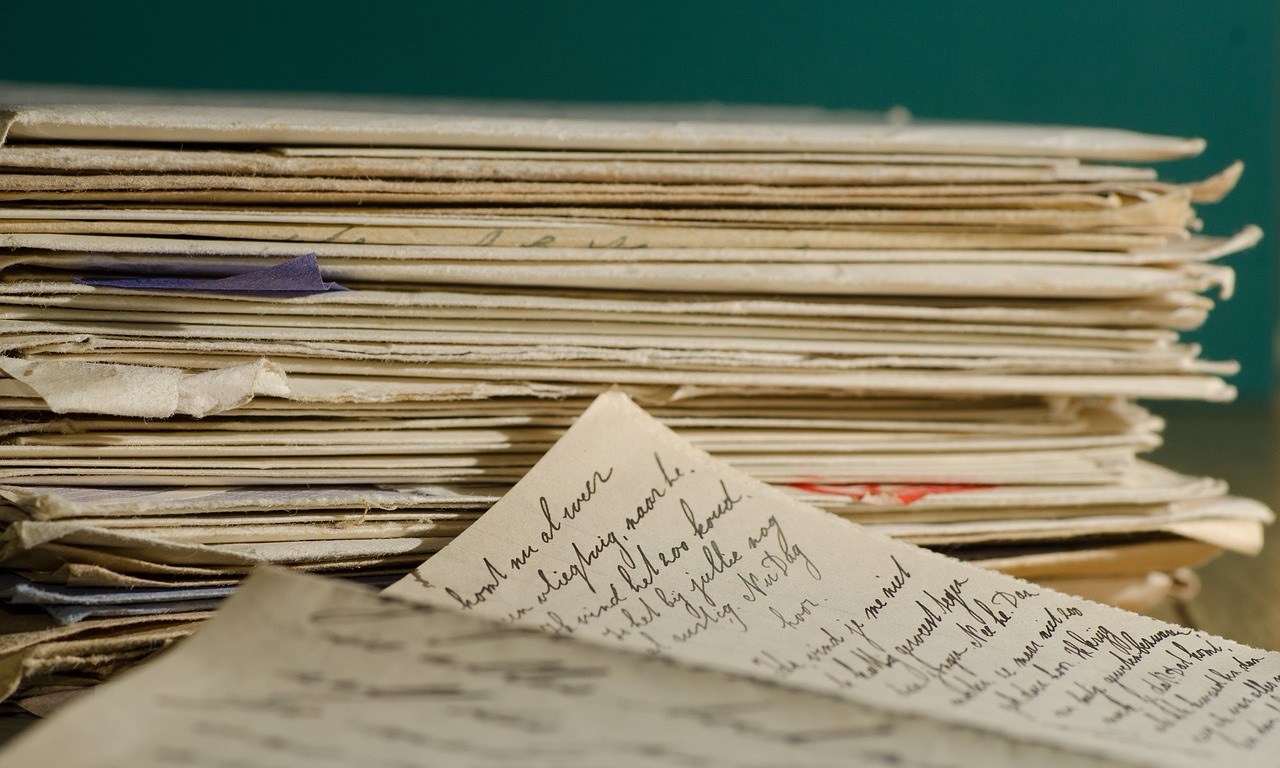
” …. don’t worry about always telling me you miss me and care about me. I love it and it really makes me feel wanted … ” And so began a letter from a high school girl to her boyfriend in college in 1964. She filled him in on chorus and cheerleading and she told him that he better take care of his cold “or you’ll have pneumonia.”
This was the first of many that I set aside one day while our center staff processed a container of paper and cardboard. She kept track of the days since she last saw him. In October, she wrote that she attended the school dance, but “all I could think about was calling you.” She did talk to him that evening, and then apologized for crying. “It’s just that I want you … I miss you more than ever.”
She wrote him nearly every day, telling him about school, tests (she figured she would fail her physics test because she studied too much), how her parents were looking forward to him coming home from college because the “refrigerator is getting crowded,” and how wonderful it was to be going steady with him for eight months.
There was nearly a four year gap in the bunch of letters that I managed to sort out of the hundreds of pounds of paper that rolled through the sort line that day. The remainder, seven additional letters, were written from him to her in late 1967 to early 1968. She was now in college; he was in the service.
It was nearly Christmas, and he was coming back home on leave. He wrote, “I hope you’re sure about the way you feel. You know it’s been a long time since you have even talked to me. Maybe I have changed more than you anticipated; more than you want.”
There was no doubt they were in love. In his next letter he encouraged her to finish college because it meant the world to her parents. He wrote of marriage and told her that he would “give almost anything to be married to you now.”
The final five letters were all written in early to mid January 1968.
The first was written just as he returned to Redstone Arsenel, Alabama, where he was stationed. He was missing her badly, and wrote that he needed her more “than anything in the world. When I say something in words they cannot come close to expressing how my heart aches for you to be at my side. Forever!”
Letters were their lifeline, and I expect there were dozens that I missed. He was desperate for her touch, and the months of separation galvanized his feelings for her. “If only I could come home to you every nite. Just to sit and hold your hand or to lay in bed with my arm around you. It would be wonderful!”
In a letter postmarked Jan. 8, 1968, he announced that he was ready for marriage, writing that he read a book at the library on the first year of marriage and told her, “We won’t have any problems now.”
Of course, his fellow servicemen told him that he was stupid for wanting to get married, but he insisted that “nothing anyone could tell me would change the way I feel in my heart about you and my intentions towards you.”
Still, as he clung to her letters and promised his love, he admitted to her that he worried about the strength of their relationship because of the distance between them and the months apart, and that she might find someone else. “You know how my mind is. It seems to be fighting a continued battle with my heart,” he told her.
The next letter was written between waxing floors and polishing boots. He also included a photo of himself and on the back he wrote, “I don’t know of any reasons why I need pictures of myself.”
He told her that until they met he never ever even considered calling a girlfriend “mushy” names like darling or my sweet or honey. “I guess the reason is that your the most wonderful person that I have ever known.”
Did they get married, have children? Why did these letters end up at a recycling facility?
I had to know.
I looked up their names on line. Both were dead. They had gotten married, but the marriage ended and he remarried. She never did. Perhaps it was too painful to their children to read about the fairytale ending that never materialized and so keeping the letters, and the loss they represented, was the last thing they wanted. Or maybe they never looked at them at all.
Perhaps in another 20 or 50 years, there won’t be love letters like these. At least none written in beautiful script and folded neatly into an envelope, knowing that someone was waiting to receive it, to read it over and over, to yearn and dream and maybe tuck it under their pillow as a way to keep the one they loved close by. We now catalog memories on phones, tablets, computers.
There is always more of this ephemera, nearly every day. The man who loved jazz and spent many years of his life corresponding with jazz enthusiasts around the world. His letters, magazines, recordings, and post cards all ended up with us. He had never married and the family that came into town to clean out his house said that no one wanted any of it.
Old bibles with family history charts filled out inside the front cover, dozens of letters from a serviceman stationed in Korea to his wife, stacks of letters and postcards from college roommates, birth certificates, death certificates, marriage certificates, all of it a snapshot of someone’s life. When we can, we separate items that may have value to our local historical societies and forward them on.
“Miss ya honey. You’re the best. .. best husband and Daddy a wife and kids could ever ask for. Thanks for taking over when you do. We will be fine, so don’t worry. The Lord will look after us.
Much love & kisses. See you Friday!”
This was written on the back of a Hallmark post card that was never sent. Maybe it was tucked in his lunch pail or left out on the table for him before he left for work. Was his job out of town or did he work a 12-hour shift? Were they having difficulties in their marriage or just young parents doing the best they could?
As much as these poignant words, written by someone long gone, tugged at my heart, one fourpage letter from a young man in prison to two of his friends in 2006 offered a stark reminder of how much the drug epidemic tore families apart in this rural area.
This loss was much different.
He thanked them both for keeping him in their prayers, and he wrote to one of them, ”you’re a kind person and don’t deserve to be a slave to drugs ever again.”
He said that he was trying to develop a good relationship with God and was studying the Bible. He had been in prison for a year and was looking at at least another six months behind bars, but felt that his faith would provide him with an arsenal to fight a war. A war with addiction. “I’m gonna use everything I know and all the resources I have to fight this shit and stay clean.”
That said, he admitted that if he wasn’t able to stay the course then he would mix the “ultimate cocktail and go out with an ultimate bang. Dead serious man, I fuck up once and see myself slipping into the hopelessness knowing I gave it my all, I’ll be mixing up the lethal load for my last high.”
He encouraged his friends to make their lives something better than his. “If you fall down 100 times, pick yourself up 101 times,” and he wrote about how happy he was for his brother – who escaped this area and found a real life with a wife, a child, and a nice home.
His troubles didn’t end after his release and he was convicted of robbery. He died eleven years after he penned the letter, and a brief press release from the county coroner sought a relative to claim his body.
I placed his four page letter in the drawer of my writing desk. It may be all that remains of his life.
 Artium