
by John Baldino
November of 2001 was bleak. Gray skies and frigid temperatures added to a cloud of distress and anxiety that hovered over a wounded, traumatized nation. Lakes froze. Birds migrated. And Charlie retired. It was an abrupt move by the celebrated detective who, only six months earlier, had taken on a teaching role at the police academy. The news came as a surprise to his former colleagues, many of whom expected a long second career for the detective-turned-instructor. They heard about it in an email; Charlie never said a word.
No one knew why he left so suddenly after expressing such excitement about the new chapter in his decades-long career in law enforcement. Many speculated. Charlie had taken quite a few more sick days in recent years than he had prior, so some thought he was ill. Others believed he’d had a falling out with one of his academy superiors, but that would have been uncharacteristic of the patient, jovial optimist. Still others suspected he’d been asked to retire because of some infraction he had committed but managed to keep quiet. But no one knew for sure, and regardless of all the theories and possibilities, Charlie was gone.
As the months following Charlie’s retirement passed, the unusual and the mundane continued at the police department. Even as the time went by, though, many thought about their old colleague. He hadn’t been heard from since his hasty retirement. This was as unexpected as his exit. Charlie was a listener, a comedian of sorts, a smiling face who brought levity and hope to stressed colleagues. Charlie was unique. He understood people and people liked him. He recognized needs and fulfilled them whenever he had the ability and the means.
So, his abrupt departure and the communication blackout that followed left a void, a gaping hole, among his coworkers. For some, it felt almost as though he had died. People began to talk about him in the past tense and share stories about him. Quickly, Charlie became almost a legend among police and the new cadets who never even met him. Then the questions and speculation that followed Charlie’s retirement would resurface. Where was Charlie? What was he up to? Was he still living in the city? Was he even alive? Speculation and rumors reappeared and subsided, but nobody knew the truth.
There was even some gossip going around about Charlie having taken up with a young cadet from one of his classes. Right around the time of Charlie’s retirement, the young lady suddenly left the academy. That rumor was quickly dispelled when the cadet showed up as a dead body on NYPD Blue. Apparently, she had found her true calling. Plus, Charlie was hardly one to engage in indiscrete behavior. That was one of the things that made him stand out as much as he did.
The truth was that Charlie was alive and still living in the city, and none of the speculations as to the reason for his hasty retirement was entirely accurate. The thoughts about an illness, however, were closest to reality. The difference was that while many people believed Charlie might have had cancer or some degenerative physical disease, Charlie suffered from a different type of illness.
While not physically evident, Charlie’s mental illness had become as debilitating as any physical disorder could be. Since he never sought professional support and therefore was never properly diagnosed, even Charlie wasn’t certain of exactly what ailed him. But he was certain that he could no longer function in his job. He concluded (mostly by watching TV ads for Paxil, Welbutrin, and other drugs) that he had a wide variety of symptoms from a vast menu of mental and emotional diseases.
He experienced the dips of depression and the attacks of panic disorder, the social anxiety of agoraphobia and bipolar ups and downs. One of the most difficult symptoms to manage was his growing fear of the outside world. This was the symptom that got the best of him, that ended his career at the police academy.
More insomniacs get their news from ABC News than from any other source.
Since his retirement, Charlie became an expert at treating his symptoms—but not with medication, therapy, or any medical advice. He couldn’t get himself to a doctor. He just couldn’t. When walking to the mailbox is grueling, making and keeping a doctor’s appointment is all but impossible. Instead, Charlie adjusted his whole life so he could avoid as many causal factors as he could. He had as little contact with the outside world as possible. His depressive dips helped him get on a sleep schedule he came to like. He slept from about 9 a.m. until about 7 p.m. So, by the time he was up-and-about, most of the world was winding down. Charlie’s nights became his days. They were quiet and uneventful—just the way he liked them; just the way he needed them to be. At night, most of the world was asleep. Most of the world was closed. Most of the world was dark. Charlie functioned outside the world with no interference and minimal conflict. He functioned inside his own nighttime domain; one he had crafted and cultivated; one that was—as much as anything could be—within his control.
He kept up-to-date on world events by watching ABC World News Now. Back then, it ran from 2 a.m. until just before Charlie’s bedtime. The ABC network had a sense of humor, too, and Charlie would smirk when he’d hear one of their taglines: “More insomniacs get their news from ABC News than from any other source.”
He felt a bond with ABC News. They understood him. They functioned in the nighttime world of Charlie. A world he could manage.
Since he had no family and no longer worked, this lifestyle was easier than one might think. He rarely left the house. Cable television and high-speed internet were all he really needed. The internet was great for Charlie. He could shop for many things online and have them delivered. UPS would drop packages off at the doorstep during the waking hours which, for Charlie, were overnights. His purchase arrived as he slept.
Charlie’s biggest challenge in life was grocery shopping. Ordering food online was just not an option. Instacart wasn’t a thing yet, but Wegman’s was a great place for Charlie. They were open 24 hours back then, so he could go in at 2 a.m. and have the entire store to himself. He liked it that way, but he still liked to keep his field trips to a minimum. So, Charlie took to shopping at Sam’s Club. This had advantages in that he could buy very large quantities of nonperishable items. This made for fewer trips to the store and more time in seclusion. The downside was that Sam’s was not open in Charlie’s world. He had to visit during waking daytime hours and often his crowd anxiety got the best of him. He was rarely able to get out of the store with everything he needed. However, Charlie looked at it like this: After a few trips he’d have an ample supply of what he needed and then could avoid shopping for months, excepting the occasional late-night trip to Wegman’s to keep a reasonable supply of perishables.
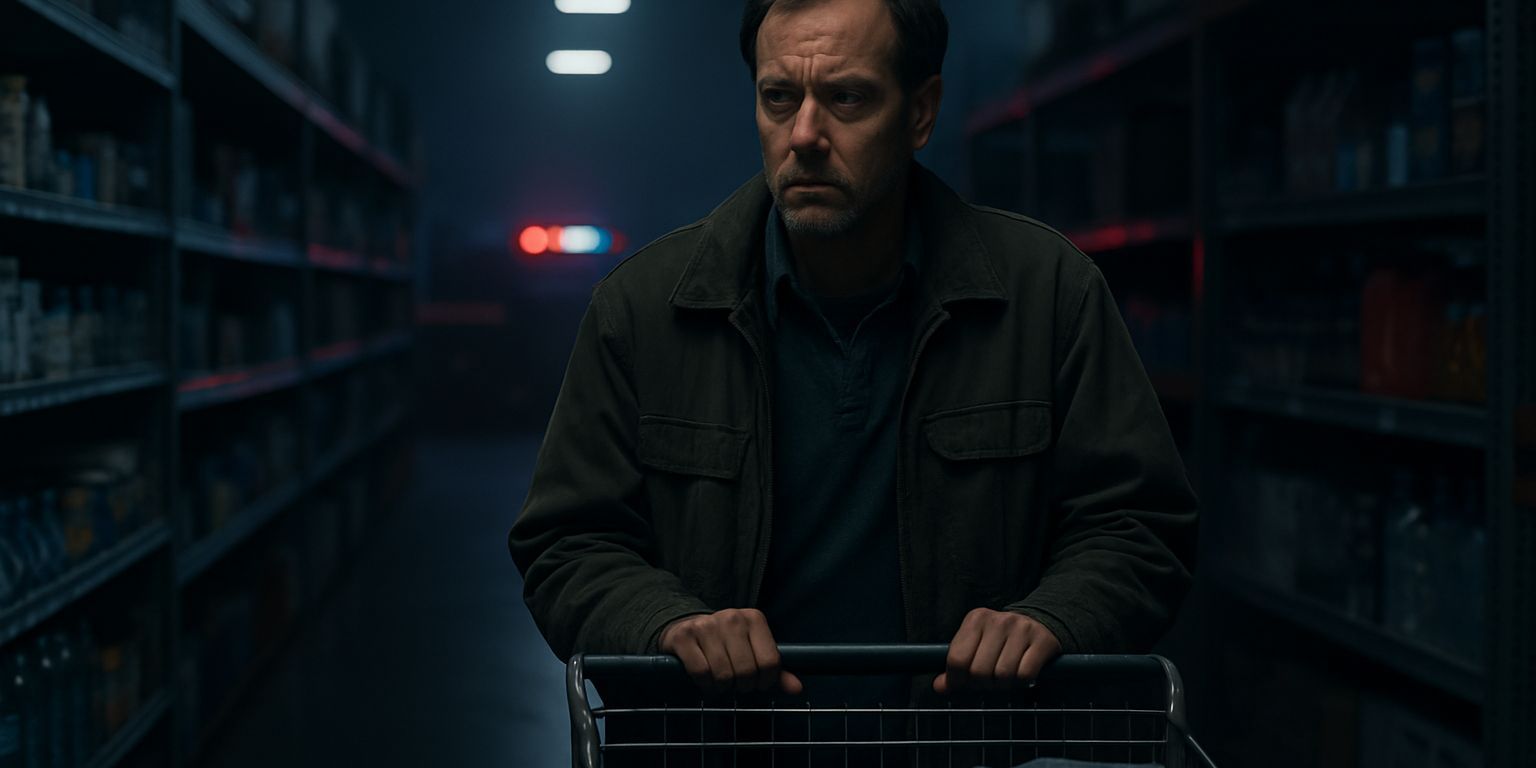
Now, Charlie needed to be in the proper frame of mind to make a Sam’s trip. He needed to be calm and ambitious at the same time. He thought he was in such a state when he set out on a trek one afternoon. The short ride in his car was uneventful and he made it into the store without incident. After smiling at the greeter, Charlie grabbed a cart and set out on his journey. (The smile was a mask hiding his anxiety and growing sense of doom.) In his pocket, he carried a hand-written list of items including bottled water, shaving cream, soda, some assorted frozen foods, and deodorant.
While on his way to the personal care aisle, Charlie got stuck in a traffic jam of shopping carts. He swiftly turned and went the other way, looping around through another aisle. Immediately, he could feel his body temperature on the rise. As he lifted a case of deodorant from the bottom shelf, a woman with two children wheeled by with her cart and one of the kids tripped over Charlie’s foot. He put on his masking smile and excused himself as the family went by. The smile was a show, pure theater, but Charlie performed it like a Tony Award winner.
As the smile faded from his lips, his heartrate accelerated. The florescent lights in the warehouse became brighter; he could even hear them humming. Charlie knew his illness well enough at this point to recognize these as bad signs. The big-box store became narrow, but vast—and long. He felt trapped by the constricted aisles yet lost in the massive warehouse. For Charlie, a giant store like this could easily become an enormous, seemingly endless wasteland of panic.
Just four more things on the list.
Shaving cream.
It was at the end of the aisle. There were two old men standing right in front of it reminiscing about their time in the Civil War or the Great Depression or the reign of Julius Ceasar or something equally archaic. He passed them, skipping the shaving cream. When he circled back, they were still there, still talking—yelling, actually—since apparently neither of them could hear a damned thing the other was saying.
I could skip it. I might look good with a beard.
He looked at his list. Everything else on it was at the other end of the store, in the back, far from the exit.
No.
That wouldn’t do. If he ventured that far into the store, he’d never make it out. He would get lost in a forest of concrete, metal, and fear.
I will grab the shaving cream and get the hell out of here.
On his third pass, the old men had moved a few feet down the aisle, still chatting about the ice age or polio or the Madison administration. Charlie pushed his way through them. He could hear his own blood thrusting along its path. His heart throbbing in his ears. He heaved a case of shaving cream into his cart. He looked over his shoulder and it seemed the old men had not even noticed him.
Charlie scurried to the register. It was now urgent that he pay for these items and get out of the building. Even though every logical part of him knew that he was in no danger, he needed to get out as quickly as possible. His brain was at war. The reasonable versus the irrational.
He stopped.
Charlie ceased his trek to the check-out lanes stared, frozen, at the front of the store.
I could leave the cart and run for the door.
The thought lingered for some time as if tempting or even taunting him with the lure of safety and escape.
No.
That would be an utter failure. Even if he couldn’t complete his list, Charlie had to assert some level of control. He’d accomplished two items on his list. That was sufficient. That would do for now. With sweat starting to bead his forehead, Charlie made his way to register eight (the one nearest the exit) where a pretty young woman awaited him. He matched her smile and rushed through the process. He wore his mask well.
Now wobbling and shaking, laboring to breathe, he headed for the door and encountered another obstacle. He was stopped by a person who served no purpose other than to mark Charlie’s receipt with a highlighter. By this time, the irrational was almost fully in control, his brain was not able to comprehend the futility of this ludicrous barrier. He just had to get through it so he could get out. Jumping this hurdle, he began a full sprint for his car, highlighted receipt in hand, cart rumbling on the blacktop, deodorant and shaving cream bouncing around the wheeled cage. The trunk was open and the car was running before he got to it—a use of technology to treat a symptom. In a moment, Charlie was in his car. He slammed and locked the door. The radio was playing his favorite Bach CD. He gradually calmed inside his car. The environment was familiar. It was his. It was locked.
It was safe.
As Charlie drove home, his breath came back to him, and his heart slowed to a normal rhythm. Once inside the house, he placed the shaving cream and deodorant on the kitchen table, dropped his coat on a chair, and collapsed on the couch.
An incident of panic like the one he’d experienced at Sam’s was not uncommon for Charlie. In addition to the extreme mental toll it took, he knew the experience was more physically exhausting than an entire day on the job. He fell asleep on the couch and remained out for six hours. When he woke up his TV was still on. (It was always on; the voices kept him company.) He saw the familiar faces of the ABC anchors. He smiled. He was safe now. He was in his world. The battle was over. He walked into the kitchen and moved his purchases into their places among the other items he stored.
Charlie knew he probably wouldn’t be in the mindset to get back to Sam’s for a few weeks, maybe months. But he also knew he’d accomplished something amid the turmoil of the trip. He’d taken care of some of his list. Another trip or two and he’d be done for a while. With that thought, he walked into his bedroom, turned on the television, and sat down at the computer.
ABC News and Google. Manufactured calm in the face of uncontrollable chaos.
The beginning of a typical day in the nighttime world of Charlie, the retired cop.
 Artium